Native Aquatic Plants, Clear Water and Care Through the Seasons
In a pond, plants are the filter, not the decoration. Put in the four plant groups in the right proportions and clear water and easy upkeep mostly take care of themselves. When a backyard pond stays green summer after summer, the usual cause is too few plants, not too little treatment. This guide uses North American natives wherever they suit, and flags the invasive water plants you should never buy.
General guidance for US backyard ponds. Unplug the pump before your hands go in the water, and use only GFCI-protected outdoor outlets. Open water is a serious drowning risk for young children; see safety. Never move plants, eggs or water between ponds or from the wild, and never dump pond plants or fish into a lake, stream or storm drain. Part of the PlantMapper Water Features section.
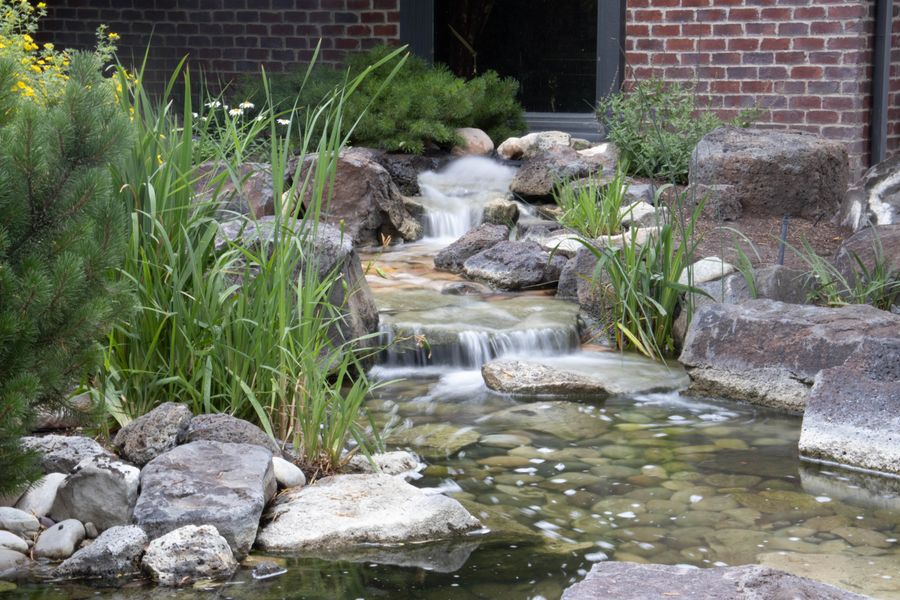
Plants are the filter, not the decoration · photograph via Pexels
How a pond stays clear
Plants are the filter
A balanced pond is one where plants use up nutrients faster than algae can. Algae is not a disease; it is what grows when there are spare nutrients and plenty of light. The answer is nearly always to cut one or both, not to add a chemical.
That means submerged plants competing for nutrients below the surface, surface cover from water lilies and floating leaves shading the water, marginals around the edge soaking up nutrients and giving shelter, and as few nutrients coming in as possible: little or no fish food, no lawn runoff, no rotting leaves, and rainwater rather than tap water where you can.
Do that and a pond more or less runs itself on about an hour of work a season. Add fish, feed them heavily, put the pond under a maple and top it up from the hose, and you will be fighting algae for years.
The four groups
What to plant, and how much
Every pond needs all four groups. The proportions matter more than the exact species.
Submerged plants
The hidden workhorses
Plants that grow fully underwater, take up nutrients straight from the water and release oxygen. They do more for clear water than anything else, and they are cheap.
Aim for roughly one bunch for every 10 sq ft of surface, more in a new pond.
Good native choices: hornwort or coontail (Ceratophyllum demersum), tape grass or wild celery (Vallisneria americana) and American waterweed (Elodea canadensis), all native across much of North America.
Avoid invasive submerged plants completely: hydrilla, Brazilian elodea (Egeria densa) and Eurasian watermilfoil (Myriophyllum spicatum) choke lakes and are banned from sale in many states. Buy from a reputable nursery and check your state's list.
Thin them by pulling some out each summer; leave it at the edge overnight so small creatures can crawl back.
Surface cover
Shade does half the work
Water lilies and floating leaves shade the water, which cuts the light algae needs and keeps the pond cooler in hot summers.
Aim for around half the surface covered in summer (roughly 50-60% is a common target), but not much more, or the water below runs short of light and oxygen.
Match the lily to the depth: dwarf types for 8-18 in, medium ones for 18-30 in. A vigorous lily in a small pond takes over. Hardy lilies suit every zone; tropical lilies are grown as annuals except in the warmest zones.
Lilies need sun, at least five or six hours, and calm water. They dislike a fountain splashing on them.
The fragrant white water lily (Nymphaea odorata) is a good native. Never buy water hyacinth, water lettuce, giant salvinia or European frogbit: they are invasive, and some states ban their sale outright.
Marginals
The pond's edge and its cover
Plants that grow in shallow water on the plant shelf. They take up nutrients, soften the edge, hide the liner and shelter everything that uses the pond.
Plant on the shelf at 8-10 in deep in aquatic baskets with heavy clay-based aquatic soil (not potting mix, which floats) and a gravel topping.
Good native choices: pickerelweed (Pontederia cordata), blue flag iris (Iris versicolor, or southern blue flag, I. virginica), arrowhead (Sagittaria latifolia), marsh marigold (Caltha palustris), lizard's tail (Saururus cernuus). Skip yellow flag iris: it is invasive in many states.
Plant thickly and let them run into the surrounding planting so there is no hard line.
Divide crowded clumps every three or four years in spring.
Damp margin and bog planting
Outside the water
Moisture-loving plants just outside the pond, ideally in a bog area fed by the overflow. It doubles the habitat and blurs the line between pond and yard.
Natives such as cardinal flower, great blue lobelia, swamp milkweed, Joe Pye weed, turtlehead and red osier dogwood, plus astilbe, ligularia, Iris sibirica and hostas.
A bog garden is just a lined hole with a few holes poked in the bottom, backfilled with soil and compost.
Leave a strip of taller grass or plants instead of mowing to the water; it is far better for wildlife.
This zone has no open water at all, which makes it useful where small children play.
Never take plants, eggs or water from another pond, a neighbor's pond or the wild. That is the main way disease and invasive species spread, and collecting from the wild can be illegal. Buy from a reputable aquatic nursery, check plants for hitchhiking snails and seeds, and let wildlife find your pond on its own. It will, sooner than you think. And never release unwanted plants or fish into a lake, stream or storm drain.
The shortlist
Plants for an American backyard pond
Chosen because they behave reasonably in a home pond, with North American natives first. Depths are below the water surface.
Aquatic and marginal plants for US backyard ponds. Check hardiness for your zone.
Plant
Group
Depth
Notes
Hornwort / coontail (Ceratophyllum demersum)
Submerged
Free-floating, any depth
Native, excellent, no planting needed: just drop it in
Tape grass (Vallisneria americana)
Submerged
1-3 ft
Native, long ribbon leaves; good fish cover
American waterweed (Elodea canadensis)
Submerged
6 in-3 ft
Native to much of North America; thin it each summer
Dwarf water lily (Nymphaea pygmy types)
Surface cover
8-18 in
For small ponds, half barrels and containers
Fragrant water lily (Nymphaea odorata)
Surface cover
18-30 in
Native; vigorous, so give it room or pick a named hybrid for a small pond
Spatterdock (Nuphar advena)
Surface cover
1-3 ft
Native, yellow cup flowers, tolerates some shade; best in larger ponds
Water lily hybrids (hardy)
Surface cover
12-30 in
Huge color range; check the mature spread before buying
Marsh marigold (Caltha palustris)
Marginal
0-4 in
Native, bright yellow spring flowers; best in cooler zones
Blue flag iris (Iris versicolor)
Marginal
0-6 in
Native; plant this, not invasive yellow flag iris
Louisiana iris hybrids
Marginal
0-6 in
Southern natives and hybrids; excellent in hot, humid zones
Lizard's tail (Saururus cernuus)
Marginal
0-4 in
Native, white drooping flower spikes; spreads
Arrowhead (Sagittaria latifolia)
Marginal
0-6 in
Native, white flowers, arrow-shaped leaves; good for wildlife
Cardinal flower (Lobelia cardinalis)
Marginal / bog
0-2 in, or wet soil
Native, scarlet spikes that hummingbirds love
Pickerelweed (Pontederia cordata)
Marginal
2-10 in
Native, blue spikes all summer; bees and dragonflies use it
Swamp milkweed, Joe Pye weed, astilbe, hosta
Bog / damp margin
Above water, kept moist
For the bog area and damp edge; milkweed feeds monarchs
Several water plants once sold everywhere are now invasive in the US, and many states ban their sale or possession: water hyacinth, water lettuce, parrot feather, yellow flag iris, purple loosestrife, hydrilla, giant salvinia, Eurasian watermilfoil and European frogbit among them. Hydrilla and giant salvinia are also federal noxious weeds. They escape into lakes and rivers and do serious damage. Check your state's invasive plant list before buying anything unfamiliar, and never dump pond plants or water into a waterway or storm drain: bag surplus invasive growth for the trash and compost the rest well away from water.
The most common complaint
Algae, green water and clarity
There are two quite different green problems, with different fixes. Knowing which one you have saves a lot of wasted treatment.
Green water: free-floating algae
Water like pea soup that you cannot see into. It is microscopic algae multiplying in warm, sunny, nutrient-rich water.
In a new pond this is normal and clears on its own in six to twelve weeks as the plants establish. Do not drain it and start over.
In an established pond it means spare nutrients: too few plants, too much sun, fish waste and food, runoff from a fertilized lawn or bed, rotting leaves, or topping up from the tap.
The fix is plants, not chemicals. More submerged plants, more surface cover up to around half the surface, and more marginals.
Cut the inputs: feed fish much less, keep leaves and runoff out, and top up with rainwater where you can.
Barley straw in a mesh bag, or liquid barley straw extract, is the traditional gentle treatment and works slowly over weeks. It is far kinder than an algaecide.
A UV clarifier clears green water quickly, but only alongside a mechanical filter, and a pond with no fish should not need either.
String algae: long green threads
Long green strands and mats that cling to plants, rocks and the liner. A different organism from green water, handled differently.
Twirl it out with a stick or a toilet brush, like winding spaghetti on a fork. It is honestly the best removal method, and it takes minutes.
Leave what you pull out at the edge overnight so the creatures in it can crawl back into the pond, then compost it away from water.
Do it little and often through spring and early summer, when it grows fastest, rather than letting it build up.
The root cause is the same as green water: nutrients and light. More shade and more competing plants reduce it.
Barley straw helps; strong algaecides do not, because the dead algae rots and puts its nutrients straight back into the water and can strip out oxygen.
A flush of string algae each spring that then settles down is normal and healthy.
Cloudy, brown or smelly water
Cloudy gray or brown usually means suspended silt, often from a pump stirring the bottom, runoff getting in, or something digging in the sediment (raccoons do this at night). Set the pump on a brick and stop runoff entering.
Tea-colored water is usually tannins from oak and other leaves and is harmless, though it tells you leaves are getting in.
A rotten-egg smell means oxygen-starved decay in a thick layer of muck and leaves on the bottom: the pond needs a partial clean-out.
An oily film on the surface is usually decaying organic matter; lay a sheet of newspaper on the surface and lift it off.
Fish gulping at the surface, especially on a hot, still night, means low oxygen. Remove decaying material and get water moving with the pump or an aerator.
If a pond suddenly goes bad after being fine, look for something that got in: runoff, a spill, fresh mortar, or lawn fertilizer or weed killer.
What not to do
Do not drain and refill a pond to clear it. You lose all the established biology and restart the green-water cycle, usually worse than before.
Do not reach for algaecides first. They treat the symptom, the dying algae rots and releases its nutrients, and many are unsuitable for ponds with fish, frogs or turtles.
Avoid big tap-water top-ups where you can: city water adds nutrients and chlorine or chloramine. If you must, add a dechlorinator.
Do not overfeed fish. Uneaten food is the biggest single source of nutrients in most fish ponds, and most backyard fish need far less than they get.
Do not expect a wildlife pond to be crystal clear all year. A slight tint, some spring algae and plenty of visible life is what a healthy pond looks like.
Keep lawn fertilizer, weed killer and runoff away from the water.
Keeping the level up
Evaporation, topping up and leaks
Every pond loses water. The useful skill is telling normal loss from a leak.
✓Normal loss
A still pond commonly loses around ½-1 in a week to evaporation in warm weather, and more in the hot, dry, windy Southwest and Plains.
A moving feature (fountain, waterfall, stream) loses much more, because splash and the extra wet surface both add to it.
A new pond also loses water to the surrounding soil soaking it up at the edges for the first few weeks.
Loss peaks in hot, dry, windy weather and is small in winter.
Top up a little at a time rather than in one big refill, which shocks the water chemistry.
Use rainwater from a rain barrel where you can; it is better for the pond and free. Tap water needs a dechlorinator.
!Signs of a leak
The level keeps dropping in rainy weather, when evaporation should be low.
The pond drops faster than about 1 in a week when the weather is not especially hot or windy.
The level falls to a certain point and then stops: that is where the leak is.
Soggy ground on one side of the pond.
Test: turn off any pump or waterfall for a few days. If the loss stops, the leak is in the stream, the tubing or the plumbing, not the pond itself.
On a liner pond most leaks are at the edge (splash, a low spot in the rim, or soil and sod touching the water and wicking it out) rather than a puncture. Check the rim level first.
Keeping it right
Routine care and cleaning
A planted pond without fish needs about an hour a season. A fish pond with a filter needs considerably more.
Skim and remove debris regularly
Scoop off floating leaves, twigs and any oily film. A net takes two minutes; newspaper laid on the surface and lifted takes the film off neatly.
Leaves that sink and rot are the main cause of foul water and low oxygen. Netting the pond in fall is the most useful maintenance job of the year.
Thin plants before they take over
Pull out some of the submerged plants each summer, divide crowded marginals every three or four years in spring, and remove extra floating growth.
Leave what you remove at the edge overnight so creatures can get back into the water, then compost it well away from any stream or lake.
Clean the pump intake, safely
Unplug the pump first, every time. Then lift it, rinse the intake screen and impeller housing in pond water, and set it back on its brick.
Monthly in summer for most features; more often for a pump sitting low in a leafy pond. A clogged intake is by far the most common reason a fountain stops.
Rinse filters in pond water, never tap water
If you have a filter, rinse the foam pads in a bucket of pond water when the flow clearly drops. Chlorinated tap water kills the bacteria the biological stage depends on.
Never let a biological filter dry out or sit switched off for days: the bacteria die and take weeks to rebuild.
Clear the muck occasionally, not often
A layer of silt on the bottom is normal and full of life. Only clear it when it is thick enough to cause foul water or smells, typically every three to five years in a planted pond.
Remove about half to two-thirds of it, not all, in fall, and leave it beside the pond for a day or two before composting it away from water.
Mosquitoes, nutrients and predators
Keep lawn fertilizer and weed killer away from the pond and the liner rim above the surrounding ground. Mosquitoes, which can carry West Nile virus, breed in still, stagnant corners: a healthy pond with fish, frogs and dragonfly larvae, a little water movement, and Bti dunks (Bacillus thuringiensis israelensis, safe for fish, pets and wildlife) where needed keeps them in check.
If you keep fish, feed sparingly, and expect raccoons and herons to find them. Steep sides, deep water, fish caves and netting help; a motion-activated sprinkler deters herons, which are protected birds, so never harm them.
Covering around half the pond with leaves is what shades out algaeMoving water loses far more to splash and evaporation than still waterNetting the pond in fall is the most useful job of the year
As an Amazon Associate, PlantMapper may earn from qualifying purchases. Prices and availability are set by Amazon. Unplug the pump before your hands go in the water, and never take plants, eggs or water from another pond or the wild.
The cold months
Winter care by zone
How much winter matters depends on where you live. In zones 7 and warmer a pond may barely skim over with ice; in zones 3-5 it can be frozen for months, and fish survive only if the pond is deep enough and a hole stays open in the ice. Find your growing zone.
✓What to do
Net the pond in fall and take the net off once the leaves are down.
Cut back dying marginal foliage before it rots into the water, but leave some stems standing for overwintering insects.
Move hardy lilies to the deep zone, and treat tropical lilies and other tender plants as annuals or overwinter them indoors.
Stop feeding fish once the water drops below about 50°F; their digestion shuts down in the cold.
In cold zones, keep a hole open in the ice with a floating pond de-icer (thermostatically controlled) or an aerator with the air stone set near the surface, so gases from decay can escape and oxygen gets in.
In zones where the pond freezes hard, pull the waterfall pump, clean it and store it in a bucket of water indoors, or as the maker advises. Never leave a stopped pump where it can freeze and crack.
!What not to do
Never smash the ice. The shock waves can stun or kill fish and other pond life.
Never pour boiling water directly on the ice, and never use salt or antifreeze.
Do not run a waterfall through a deep freeze: ice dams can divert water over the edge and drain the pond, and the moving water chills the warmer layer at the bottom where fish rest.
Do not leave a container feature full to freeze solid; ceramic, stone and glazed pots crack when the water inside expands.
Do not clean out muck or disturb the pond in winter, when everything in it is dormant.
Do not keep fish over winter in a cold-zone pond that is too shallow. Around 24-30 in is common in moderate cold, and 3 ft or more is wise in zones 3-4.
For a container water feature, winter is the real risk anywhere it freezes: a half barrel or glazed pot can freeze solid and crack. Drain it and store it under cover, and in mild zones a floating ball can absorb some of the expansion. Move tender plants into a tub of water in a frost-free garage or basement, and bring small pumps in to store dry.
Diagnosis
Eight problems and what usually causes them
Match the symptom to the cause. Nearly every water quality problem comes down to nutrients, light or rotting material.
Common pond problems, their usual causes and what to try first.
Symptom
Most likely cause
What to do
New pond has turned green
Normal: plenty of nutrients and no competition yet
Nothing. Plant it well and wait six to twelve weeks
Established pond stays green
Too few plants, too much sun, or nutrients getting in
Add submerged plants and surface cover over about half the area; stop the nutrient input
String algae every spring
Normal seasonal flush; worse with spare nutrients
Twirl it out on a stick, little and often; add shade and competing plants
Water level dropping in rainy weather
A leak rather than evaporation
Turn the pump off for a few days; if the loss stops, it is the stream or plumbing. Otherwise check the rim level and edges first
Fountain has stopped or slowed
Clogged pump intake or impeller
Unplug the pump, lift it and rinse the intake in pond water
Rotten-egg smell
Oxygen-starved decay in thick muck and leaves
Remove some of the muck; net the pond each fall from now on
Cloudy gray or brown water
Silt stirred up by a pump on the bottom, raccoons digging, or runoff getting in
Raise the pump on a brick; stop runoff getting in
Fish gulping at the surface
Low oxygen, worst on hot, still nights
Remove rotting material, add an aerator or water movement; feed less
The routine
A pond through the year
Four short sessions, timed by your weather rather than the calendar. Fall is the one that matters most.
Spring
From ice-out or when the water warms
The busiest season, in the pond and for you. That may be February in zone 9 and late April or May in zone 4. Frogs and toads lay eggs, plants wake up and string algae has its first flush.
Divide and repot crowded marginals, and top baskets up with fresh aquatic soil.
Start twirling out string algae as it appears, little and often.
Clean and reinstall the pump once hard freezes are over, unplugging it first.
Resume feeding fish lightly once the water stays above about 50°F, and add new plants as it warms.
Leave frog and toad eggs alone, and never move them between ponds.
Summer
The warm months
Watching, topping up and thinning. The pond should mostly run itself.
Top up a little at a time; loss is highest now, especially in the Southwest.
Thin submerged plants and floating growth, leaving what you remove at the edge overnight.
Clean the pump intake monthly, and check still corners for mosquito larvae.
Watch for fish gulping on hot, still nights, feed less, and keep an eye out for raccoons and herons.
Enjoy it: this is when a pond pays you back.
Fall
Before and during leaf drop
The most important season. What you do now decides how the pond behaves next year.
Net the pond before the leaves drop and keep the net clear.
Cut back dying marginal foliage before it rots into the water.
Remove some muck if it is thick, leaving it beside the pond for a day or two.
Stop feeding below about 50°F; pull and store the pump in cold zones, or set up the de-icer.
Bring tender plants and container features in out of harm's way.
Winter
After the first hard freeze
Leave it alone. The jobs are about protecting the pond, not working on it.
Take the net off once the leaves are down.
Keep a hole open with a floating de-icer or surface aerator in cold zones; never smash the ice.
Check the de-icer is working after every cold snap, on its GFCI outlet.
Protect container features from freezing solid.
Do not clean out muck, disturb the pond or run a waterfall in a deep freeze with fish in it.
Avoid these
Six planting and care mistakes
These are the ones that keep a pond green, lifeless, or in a constant battle.
1. Too few plants, then treating the algae
Nearly every backyard pond that stays green is short of plants, not short of treatment. An algaecide clears it for two weeks, the dead algae rots and returns its nutrients, and the bloom comes back.
The fixPlant it properly: submerged plants at roughly a bunch per 10 sq ft, surface cover over about half the area, and thick marginals. Then cut the nutrient input. Clear water follows.
2. Draining and refilling to clear the water
This wipes out the pond's established biology and restarts the green-water cycle, usually worse than before, and it kills much of the life in it.
The fixNever drain a pond to clear it. Plant it, shade it, keep nutrients out and wait. Only ever part-clear the muck, every three to five years, and leave it beside the pond overnight.
3. Buying invasive plants or moving material between ponds
Moving plants, eggs or water between ponds spreads disease and invasive species, and collecting from the wild can be illegal. Water hyacinth, water lettuce, parrot feather and yellow flag iris are still sold in places, yet they escape into lakes and rivers and are banned in many states.
The fixBuy natives from a reputable aquatic nursery, check your state's invasive plant list before buying anything unfamiliar, and let wildlife find the pond on its own. It does so remarkably fast.
4. Skipping the fall netting
Leaves that sink and rot are the biggest single cause of foul water, low oxygen and thick muck, and one neglected fall creates work for years.
The fixNet the pond before leaf drop, keep the net clear, and take it off once the leaves are down. It is the best-spent hour in the whole pond year.
5. Smashing the ice
Hitting ice sends shock waves through the water that can stun or kill fish and other pond life. Pouring boiling water on is not much better.
The fixKeep a hole open with a floating pond de-icer or a surface aerator. In an emergency, set a pan of hot water on the ice and let it melt through.
6. Overfeeding fish
Uneaten fish food is the biggest single source of nutrients in most fish ponds, and it feeds exactly the algae the owner is fighting. Most backyard fish are fed several times what they need.
The fixFeed only what they eat in a few minutes, less in cool weather, and nothing once the water is below about 50°F. Better still, keep no fish in a wildlife pond.
Print it or tick as you go
The planting and care checklist
Fourteen jobs across the year. Your ticks are saved in this browser only.
Planting
Routine
Seasonal
Questions
Pond planting and care: your questions answered
Eight answers to the questions that come up most.
Why is my pond water green, and how do I clear it?
Green water is microscopic algae multiplying on spare nutrients and plenty of light. In a new pond it is completely normal and clears on its own in six to twelve weeks. In an established pond it means the plants are not keeping up: add submerged plants, get lily pads and floating leaves over about half the surface, and plant the edges thickly. Then cut the nutrient input: less fish food, no lawn runoff, leaves netted out in fall, rainwater for top-ups. Plants are the cure, not chemicals.
How do I get rid of string algae?
Twirl it out on a stick or toilet brush, like spaghetti on a fork. It is honestly the most effective method and takes minutes. Do it little and often through spring and early summer instead of letting it build up, and leave what you pull out at the edge overnight so creatures can crawl back before you compost it away from water. Over time, more shade and more competing plants reduce it. Strong algaecides backfire, because the dead algae rots and returns its nutrients to the pond.
What plants do I need in a backyard pond?
Four groups, and the proportions matter more than the species. Submerged plants at roughly one bunch per 10 sq ft, such as native hornwort, tape grass and American waterweed. Surface cover from water lilies or spatterdock over about half the surface in summer. Marginals planted thickly on the shelf at 8-10 in, such as pickerelweed, blue flag iris, arrowhead and marsh marigold. And bog plants such as cardinal flower and swamp milkweed just outside the water. Together they are the pond's filter.
Which water plants are invasive in the US?
Several popular pond plants are serious invaders that escape into lakes and rivers: water hyacinth, water lettuce, parrot feather, yellow flag iris, purple loosestrife, hydrilla, giant salvinia, Eurasian watermilfoil and European frogbit are the best known. Many states ban their sale or possession, and hydrilla and giant salvinia are federal noxious weeds. Check your state's invasive plant list, buy natives such as pickerelweed, blue flag iris and arrowhead instead, and never dump pond plants, water or fish into a waterway or storm drain.
How often should I clean out a pond?
Far less often than people think. A layer of silt on the bottom is normal and full of life, and a planted pond usually needs only a partial clean-out every three to five years, in fall, removing about half to two-thirds of the muck rather than all of it. Leave what you take out beside the pond for a day or two so creatures can return, then compost it away from water. Never drain and refill a pond to clear the water: it destroys the biology and makes things worse.
How do I stop my pond losing water?
First work out whether it is evaporation or a leak. A still pond commonly loses around ½-1 in a week in warm weather, more in hot, dry, windy regions, and a fountain or waterfall loses much more. If the level keeps dropping in rainy weather, or falls to a certain point and stops, you have a leak. Turn any pump off for a few days: if the loss stops, the problem is in the stream or plumbing, not the pond. On a liner pond most leaks are at the edge (a low spot in the rim, splash, or soil wicking water out), so check the rim level before assuming a puncture.
How do I keep fish alive in a frozen pond over winter?
Make sure the pond is deep enough not to freeze solid (around 24-30 in is common in moderate cold, 3 ft or more in zones 3-4), stop feeding once the water is below about 50°F, and keep a hole open in the ice so gases can escape: a thermostatic floating pond de-icer on a GFCI outlet, or an aerator with the air stone near the surface, does the job. Never smash the ice, as the shock waves can stun or kill fish, and never use boiling water, salt or antifreeze. Net out leaves in fall so less rots under the ice.
How do I keep mosquitoes out of my pond?
A balanced pond is rarely a big mosquito source, because fish, frogs, dragonfly larvae and water striders eat the larvae and moving water discourages egg laying. Mosquitoes, which can spread West Nile virus, breed mainly in still, stagnant spots: neglected corners, clogged gutters, saucers and bird baths. Add a small pump, bubbler or fountain, keep a few fish where they suit the pond, change bird bath water every few days, and use Bti dunks (Bacillus thuringiensis israelensis), which are safe for fish, pets and wildlife, where water must stay still. Mosquito fish (Gambusia) are restricted in some areas, so check locally first.