Low-Maintenance Garden Guide

Low-Maintenance Yard Ideas: How to Plan an Easy-Care Garden That Fits Your Zone

An easy-care yard comes down to one trade: a few good decisions up front in exchange for free weekends for years. Pick plants that actually like your zone, rainfall and soil, cover the ground so weeds have nowhere to start, shrink the lawn you mow every week, and let drip irrigation and mulch handle the watering. Whether you are busy, gardening into retirement, or just want more time on the deck than behind the mower, this is the most relaxing way to have a good-looking yard.

Low-maintenance never means no maintenance, but it can mean a fraction of the work. An hour of planning now saves years of chores later.

A relaxed, easy-care garden with a path leading past a rustic house in warm light
A relaxed, easy-care yard that needs only a light touch · photograph via Pexels
The basics

What is a low-maintenance garden?

A low-maintenance yard is planned from day one to look good with as little work as possible. It is not a neglected yard, or a bare one covered in rock; it is one that works with you instead of against you. Choose tough plants suited to each spot, many of them natives that already know your climate, cover bare soil so weeds cannot get going, lean on evergreen structure for winter, and design out the jobs that eat your weekends: mowing, watering, staking and shearing. The result is a neat, restful yard that gives back far more than it asks.

Why low-maintenance yards work

More time to enjoy

That is the point: less time working on the yard, and a lot more time actually sitting in it.

Kinder on the body

Less bending, lifting, mowing and shearing: a manageable yard that stays a pleasure as the years go by.

Looks good all year

Evergreen structure, grasses and tough perennials keep it neat and handsome in every season, not just in June.

Cheaper & greener

Fewer replacements, less watering and no constant fertilizing mean a lower water bill and a yard that treads more lightly.

Still full of life

Native, nectar-rich plants and seed heads left standing make an easy-care yard a haven for native bees, monarchs and songbirds such as goldfinches and chickadees.

Less stress, more calm

A yard that never feels like a backlog of chores is a far more relaxing place: calm by design, not by accident.

How it compares with other garden styles

Low Maintenance Garden

Tough plants, groundcovers and mulch in an easy-care design: a neat, restful yard that largely looks after itself.

You are here

Gravel Garden

Drought-tolerant planting through gravel: one of the very lowest-upkeep styles of all.

Coastal Garden

Tough salt- and wind-tolerant plants that need little fussing once established.

Mediterranean Garden

Sun-baked, drought-loving herbs and silver foliage: easy-care and water-wise, especially in the West.

Wildlife Garden

Planned for nature, and famously relaxed, since a little wildness is the point.

Design formula

The principles of easy-care gardening

Almost all the work in a yard comes from a handful of high-effort habits. Reverse each one and the chores disappear before they start. These six principles are the whole secret.

Right plant, right place

A plant suited to its spot thrives on neglect. Match each one to your zone, sun, soil and rainfall, and favor natives and proven performers for your region, and it will need almost nothing from you.

Cover every gap

Bare soil means weeds and watering. Knit the ground together with groundcovers and mulch so there is no room for trouble.

Build an evergreen backbone

A frame of evergreen shrubs keeps the yard looking deliberate and neat all year, with no seasonal gaps to fill or fuss over.

Shrink the lawn

Lawn is the thirstiest, most time-hungry part of most American yards. Shrink it, or replace part of it with planting beds, groundcover or a meadow patch, and mowing, fertilizing and watering shrink with it. Check HOA rules before you rip out a front lawn.

Repeat reliable plants

A few dependable plants repeated in sweeps looks calm and intentional, and is far less work than a fussy mix of one of everything.

Avoid high-upkeep plants

Skip plants that need staking, deadheading, spraying or hard pruning, and plants deer treat as a buffet if you have deer. Choose self-supporting, slow-growing, trouble-free ones instead.

The one rule that saves the most work: right plant, right place. A plant growing where it is genuinely happy needs no coaxing, no fertilizer and no fighting; it simply gets on with it.

Free plant guide

Best low-maintenance plants

These ten are dependable workhorses for an easy-care yard: tough, long-lived and happy to be left alone. Check each against your USDA zone, repeat the ones that suit you, and filter the wider range by your own conditions in the Plant Finder.

Lavender

Lavandula angustifolia

Fragrant, evergreen in mild zones and loved by bees, lavender needs only sun and sharp drainage, and deer and rabbits leave it alone. One trim a year keeps it neat. Zones 5-8; in the humid South grow it in raised, gravelly beds.

Sun & scentEvergreenOne trim a year

Bigroot geranium

Geranium macrorrhizum

One of the easiest groundcovers there is: a weed-smothering, deer-resistant carpet that copes with sun or dry shade and flowers for weeks. Zones 4-8.

Weed-smotheringSun / shadeTrouble-free

Ornamental grasses

Panicum, Schizachyrium, Festuca

Movement, texture and months of interest for almost no work. One cutback in late winter is the whole year’s care. Native switchgrass, little bluestem and prairie dropseed are tough choices in zones 3-9; avoid Mexican feather grass in California, where it is invasive.

Year-round interestSunCut once a year

Sedum (stonecrop)

Hylotelephium spectabile

Drought-proof, deer resistant and loved by butterflies, with flat flower heads that fade to handsome seed heads. Stands all winter and needs no watering. Zones 3-9.

Drought-proofSunWinter structure

Euphorbia

Euphorbia characias

Bold evergreen domes of blue-green leaves with lime-green spring flowers: architectural, drought-proof and ignored by deer. Zones 7-10, best in the West and mild South; the sap irritates skin.

Evergreen structureSunDrought-proof

Coral bells (Heuchera)

Heuchera

A North American native genus. Evergreen to semi-evergreen mounds of ruffled color, from lime and amber to plum and silver, that brighten edges and pots. Most do best in zones 4-9 with afternoon shade in hot regions.

Year-round colorPart shadeEvergreen

Hebe and tidy evergreen shrubs

Hebe (Veronica)

Neat evergreen shrubs that keep their shape without shearing. Hebes suit mild West Coast yards (zones 8-10); elsewhere, get the same no-clip shape from native inkberry holly, dwarf yaupon or compact Japanese holly.

No-clip shapeSunEvergreen

Catmint

Nepeta

A long-blooming haze of blue that buzzes with bees from late spring into fall. Drought tolerant, deer resistant, self-supporting and revived with one midsummer shear. Zones 3-8.

Long floweringSunSelf-supporting

Bergenia

Bergenia

Bold, leathery evergreen leaves that smother weeds in sun or shade, often turning red in winter, with pink spring flowers. Practically indestructible in zones 3-8, though it dislikes hot, humid summers.

Evergreen coverSun / shadeIndestructible

Lady’s mantle

Alchemilla mollis

Soft mounds of pleated leaves that hold raindrops, topped with a froth of lime-green flowers. Tough, shade tolerant and easy in zones 3-8; it can melt in Southern heat.

Easy frothSun / shadeSelf-seeds
Region by region

Low-maintenance yards across the US

What counts as ‘easy’ changes with the climate: in Phoenix it is about water, in Connecticut it is about deer, in Georgia it is about plants that do not outgrow their spot in one summer. Start with your USDA zone, then plant for your region.

Northeast & Midwest

Zones 3-7. Deer are often the biggest maintenance problem, so build around deer-resistant natives and tough perennials: coneflower, catmint, Russian sage, little bluestem, bigroot geranium, ninebark and inkberry. Rake fall leaves into beds as mulch rather than bagging them.

Southeast & Gulf Coast

Zones 7-10. Plants grow fast in the heat and humidity, so choose ones that stay compact and shrug off disease: dwarf yaupon, native coreopsis, black-eyed Susan, muhly grass, lantana in warm zones and pine straw mulch. Avoid plants that sulk in humid summers, such as lavender in heavy soil.

Southwest & California

Zones 7-11. Water is the big cost, so a low-maintenance yard here is a xeriscape: drought-adapted natives, gravel mulch and drip irrigation on a timer. Think desert marigold, penstemon, salvias, red yucca, deer grass and California buckwheat. Many water utilities offer rebates for replacing turf.

Pacific Northwest

Zones 6-9. Wet winters and dry summers. Natives such as sword fern, salal, Oregon grape, red-flowering currant and kinnikinnick look after themselves, and a fall mulch keeps weeds down through the rainy season. English ivy and English holly are invasive here; do not plant them.

Mountain West & Plains

Zones 3-7. Wind, cold, intense sun and low rainfall. Tough natives shine: blue grama and buffalograss as lawn alternatives, rabbitbrush, prairie zinnia, blanket flower, penstemons and little bluestem. Group plants by water needs so one drip zone does not drown the drought lovers.

Before you remove lawn: check your HOA rules and any local ordinances on front-yard planting and plant height. Many cities and water districts now encourage lawn replacement, and some offer rebates, but the details vary a lot from place to place.

Lush, drought-tolerant succulents established among greenery in a yard
Tough, slow-growing plants give year-round structure with very little work
Cover the ground

Groundcover plants

Groundcover is the easy-care gardener’s secret weapon. A living carpet over the soil smothers weeds, holds moisture and looks far better than bare dirt or landscape fabric, and once it knits together it does the job for free, every year. It is also a great way to replace lawn under trees, where grass struggles anyway.

Hardy geraniums

Tough cranesbills such as G. macrorrhizum form dense, weed-proof carpets in sun or shade and flower for weeks: the best all-rounder for zones 4-8.

Pennsylvania sedge

A soft, fine-textured native sedge (Carex pensylvanica) that forms a low, no-mow carpet in dry shade under trees. A favorite lawn substitute in zones 3-8.

Bugleweed (Ajuga)

A low, glossy, fast-spreading mat with blue spring flower spikes, good weed-suppressing cover for moist, shady ground. Keep it away from lawns, which it will happily invade.

Avoid vinca & English ivy

Periwinkle (Vinca minor) and English ivy are sold everywhere as easy groundcovers, but both are invasive in many states and escape into woods. Use native alternatives such as wild ginger, green-and-gold, foamflower or Allegheny spurge.

Creeping thyme

A fragrant, flowering mat for hot, dry, sunny spots and between pavers: tough underfoot, loved by bees, ignored by deer and never needs mowing. Zones 4-8.

Epimedium

One of the best covers for dry shade under trees: dainty spring flowers over heart-shaped leaves, deer resistant and weed-proof for almost no work. Zones 5-8.

Plant groundcovers close. Set young plants a little closer than usual so they knit together quickly. Mulch well around them at planting, and within a season or two they will carpet the ground and the weeding nearly stops.

Year-round form

Evergreen structure

Evergreens keep a low-maintenance yard looking deliberate and cared for in every month. A simple backbone of evergreen shrubs gives the yard shape and substance with no seasonal gaps, and most need no more than an occasional trim.

Evergreen mounds

Naturally rounded shrubs, such as dwarf mugo pine, compact junipers, inkberry and, in mild zones, hebe, that hold a neat dome without shearing. All the structure of formal topiary with none of the upkeep.

Inkberry & pittosporum

Glossy evergreens that make trouble-free shrubs or informal hedges: native inkberry holly in zones 5-9, Japanese pittosporum in zones 8-11 across the South and California.

Boxwood alternatives

Boxwood blight and the box tree moth now affect boxwood in many states. For low edging, try inkberry, dwarf yaupon or compact Japanese holly instead: the neat look, far less risk.

Architectural evergreens

An Adam’s needle yucca (zones 4-10), a fatsia in mild shade or a phormium on the West Coast gives instant, year-round impact and never needs pruning. One strong shape can anchor a whole easy-care bed.

Evergreen grasses & sedges

Evergreen sedges and grasses hold their color and movement through winter, soft low structure that rarely needs more than a comb-through.

Evergreen groundcover

Bergenia, coral bells, creeping juniper and euphorbia keep the lower layer furnished all winter, with structure right down to the ground and no bare soil on show.

Aim for about half to two-thirds evergreen. If most of your structural planting stays green through winter, the yard never looks bare, and you avoid the big fall cleanups that mostly deciduous yards demand. In snowy zones, evergreens also give winter cover to cardinals and other birds.

Dress the soil

Gravel & mulch

If one job pays back more than any other in saved effort, it is mulching. A good layer of shredded bark, pine straw, gravel or compost quietly does the weeding, watering and tidying for you, all year, for the price of an afternoon.

Why mulch matters

Mulch blocks light from weed seeds, holds moisture in the soil and feeds the ground as it breaks down: three big jobs at once.

Bark, pine straw & compost

Organic mulches suit planting beds and improve the soil over time. Shredded hardwood is common in the Northeast and Midwest, pine straw across the Southeast. Top up each spring.

Gravel mulch

Gravel is the lowest-upkeep mulch of all. It never rots, suits sunny drought-tolerant planting and xeriscapes in the West, sets plants off well and lets them self-seed.

Get the depth right

Aim for 2 to 3 inches. Too thin and weeds push through; too deep or piled against trunks (the ‘mulch volcano’) invites rot and rodents. Keep it a few inches back from stems.

Landscape fabric: paths only

Weed fabric belongs under paths and gravel patios, not planted beds, where it stops plants spreading and self-seeding and weeds root in the mulch on top anyway. Mulch the beds instead.

Top up once a year

One refresh in spring keeps mulch working. That single job replaces a whole season of weeding and watering: the best trade in gardening.

Mulch is the busy gardener’s best friend. Clear the weeds once, water the soil, then spread a thick mulch over moist, planted ground. From then on the yard stays cleaner and greener for a fraction of the effort. In fall, rake leaves into beds as free mulch rather than bagging them.

The big three jobs

Less weeding, watering & pruning

Weeding, watering and pruning eat most of a gardener’s time. Each can be designed almost entirely away. Here is how to shrink all three.

Weeding · leave no bare soil

Weeds need light and space. Take both away with groundcovers and a thick mulch, and most weeding disappears before it starts.

Weeding · edge it cleanly

A crisp edge of steel, brick or a concrete mowing strip stops grass and weeds creeping into beds: one clean line that saves endless trimming.

Watering · choose drought-tolerant plants

Plants that cope with dry spells need no hose once established. Lean on natives and plants proven in your region, and in the arid West follow xeriscape principles, and summer watering can almost stop.

Watering · drip irrigation & mulch

Drip lines on a timer, or a smart controller that skips watering after rain, deliver water to roots with almost no waste. When you do hand-water new plants, soak them deeply but rarely to grow tough, self-reliant roots.

Pruning · pick slow, tidy plants

Choose shrubs that naturally stay the right size and shape for the spot. A plant that never outgrows its space never needs hacking back or staking.

Pruning · skip the sheared hedges

Sheared hedges and topiary mean endless trimming. Swap them for informal, free-growing shrubs and grasses you cut back once a year, if at all.

Design the jobs out, don’t just keep up with them. Nearly every recurring chore can be removed at the planning stage with a better plant choice or a thicker mulch. An hour of thought now is worth a hundred Saturday afternoons later.

Learn the easy way

Common low-maintenance mistakes

Most of these quietly create work where none is needed. Avoid them and the yard stays easy for years.

!Too much lawn

Lawn is the single most time-consuming feature in most American yards. Keeping more than you actually use means mowing, edging, fertilizing and watering you could design away.

!Leaving bare soil

Every patch of open ground is an invitation to weeds. Cover it with planting or mulch and weeding shrinks to almost nothing.

!Choosing fussy or deer-candy plants

Plants that need staking, deadheading, spraying or winter protection turn a yard into a chore list. Where deer roam, hostas, daylilies and arborvitae become an endless battle. Pick tough, deer-resistant plants instead.

!The wrong plant, wrong place

A plant fighting its conditions needs constant help. Match each plant to its spot and it thrives on neglect, the opposite of high-maintenance.

!Planting invasives

Many ‘easy’ plants are easy because they spread: Japanese barberry, burning bush, English ivy, vinca and Bradford (Callery) pear are invasive in many states. They create years of removal work for you and your neighbors. Check your state’s invasive plant list first.

!Overcomplicating it

A busy yard of one-of-everything is fiddly to care for. A few reliable plants, repeated in generous sweeps, looks calmer and is far less work.

Copy this

Example low maintenance garden schemes

Four ready-made ideas for an easy-care yard. Lift one straight in, or adapt it to your space, your zone and how much (or little) you want to do.

Low-maintenance front yard

Curb appeal · almost no upkeep

  • Surface: planting beds and gravel instead of most of the lawn
  • Structure: a few unsheared evergreen mounds such as inkberry or dwarf mugo pine
  • Movement: sweeps of little bluestem or prairie dropseed
  • Flowers: catmint, coneflower, sedum & black-eyed Susan
  • Finish: a thick mulch throughout

A welcoming, neat front yard with very little mowing and barely any watering: smart all year, for an afternoon’s care each season.

Easy evergreen courtyard

Small & paved · minimal effort

  • Backbone: evergreen shrubs in big pots
  • Layer: coral bells, hostas (if deer cannot reach) & ferns
  • Accent: one architectural yucca or phormium
  • Surface: pavers with gravel joints
  • Watering: a simple drip system on a timer

A green, restful courtyard or patio that looks good every month: group the pots, set the drip line on a timer, and there is almost nothing left to do.

Low-care mixed bed

Sunny bed · planted once

  • Frame: repeated inkberry or other evergreen shrubs
  • Body: bigroot geranium, sedum & coneflower
  • Haze: switchgrass & catmint
  • Ground: geranium & Pennsylvania sedge carpet
  • Mulch: shredded bark, topped up each spring

A full, flowering bed with the soil completely covered, so it weeds itself, needs little water and asks for one cleanup a year.

Raised-bed easy-access garden

Gentle on the back · all abilities

  • Beds: waist-high raised beds, no bending
  • Paths: firm, level and wheelchair-friendly
  • Plants: compact evergreens, herbs & a few vegetables
  • Watering: a drip line into each bed
  • Seating: a sheltered spot to sit and enjoy

Gardening made comfortable: everything within easy reach, no kneeling or heavy lifting, and all the pleasure of growing without the strain.

An easy-care yard of diverse, undemanding plants in full bloom
Choose undemanding plants once and the yard largely looks after itself
Find your plants

Explore easy-care plants in the Plant Finder

Browse and filter the wider PlantMapper range by your own zone, light, soil and space. These shortcuts are a good place to start a low-effort plan.

Free planning tools

Helpful garden calculators

Plan the practical side of an easy-care yard, from plant numbers to mulch and bed prep, with our free calculators.

Useful for a low-maintenance yard

Our picks

As an Amazon Associate, PlantMapper may earn from qualifying purchases. Prices and availability are set by Amazon.

The goal

A low-maintenance yard, settled in

Get the planting and surfaces right once and the yard settles into a neat, good-looking space that needs only the lightest touch to keep it that way.

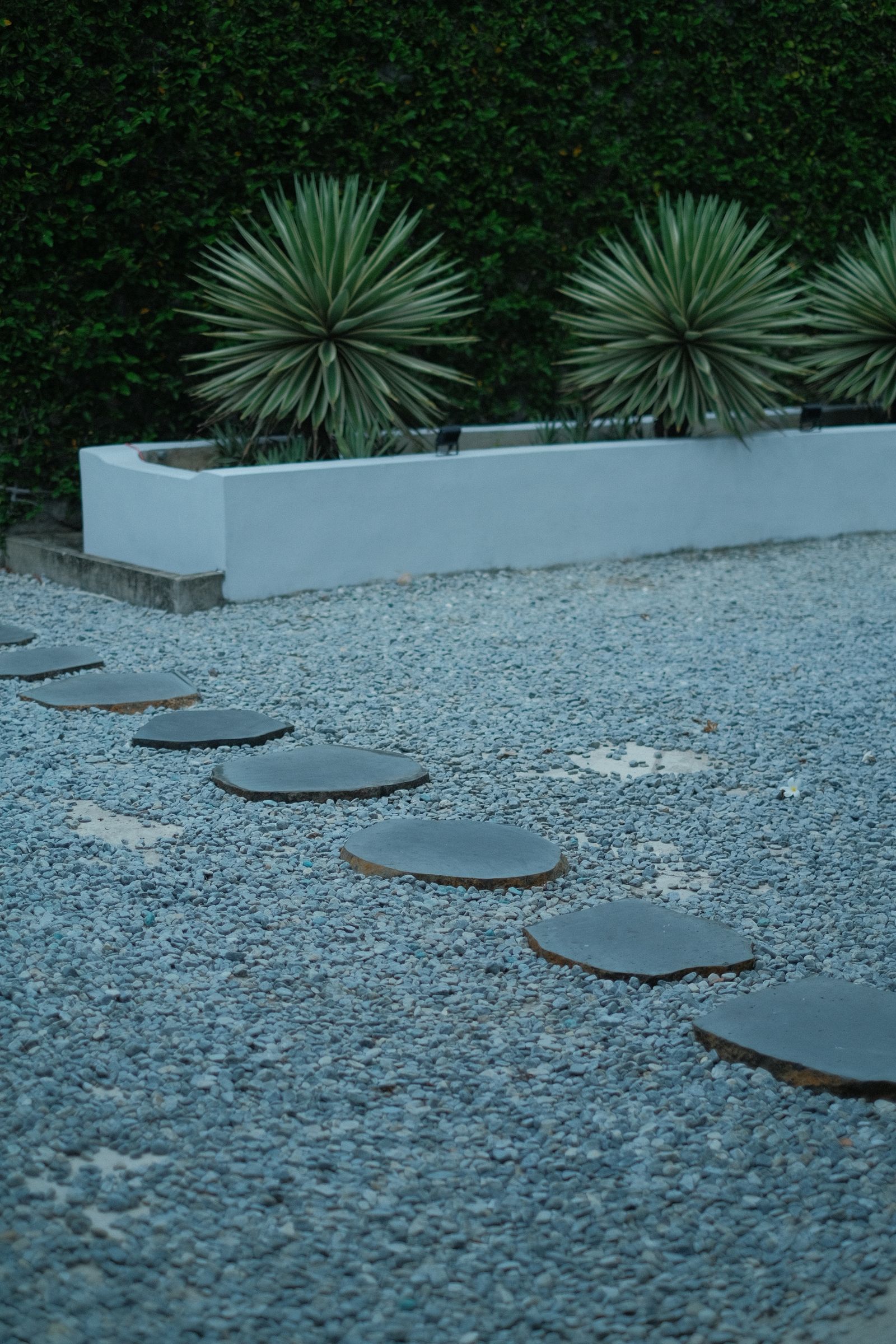
An established low-maintenance garden with agave, gravel and a stone path
An established low-maintenance yard: gravel, evergreens and architectural planting that stays neat
The PlantMapper Collection

The Low Maintenance Garden Starter Kit

Everything on this page is free to use: the principles, plant groups, schemes and time-saving tricks. The Low Maintenance Garden Starter Kit is an optional next step, a printable workbook that pulls it all together so you can plan the whole yard away from the screen. It was written for the original edition of PlantMapper, so swap in plants for your zone using this page and our free garden calculators and Plant Finder.

Effort-audit worksheets

Map where your yard time really goes, and plan the simple swaps (less lawn, more groundcover, thicker mulch) that cut the most work.

Design grids

Scaled and dot grids for sketching easy-care beds to size, with a key for evergreens, grasses and groundcovers.

Planting plans

Ready-made and blank plans for low-care beds, gravel schemes and raised beds, with reliable, trouble-free combinations.

Easy-care plant directory

Profiles of the toughest, most reliable plants, from evergreens to groundcovers and grasses, matched to light and soil.

Maintenance schedules

Season-by-season checklists: the few small jobs that keep an easy yard easy, and nothing more.

Garden journal

Pages to record what thrived on neglect and what you will simplify next, so your yard gets easier year after year.

Printable digital workbook

Download the Low Maintenance Garden Starter Kit

An instant digital download in US Letter and A4. Print it at home as often as you like and design a yard that looks after itself. Inside: the Maintenance Reduction Pyramid, the 1-Hour Garden Rule, maintenance-audit worksheets, a low-effort planting framework, an evergreen-led plant directory and simple seasonal checklists. It sits alongside our Cottage, Mediterranean, Tropical, Shady and Wildlife garden kits.

Download the Starter Kit on Etsy (UK edition)

A printable workbook for your own yard. The right one-time decisions now buy you years of easy, good-looking weekends.

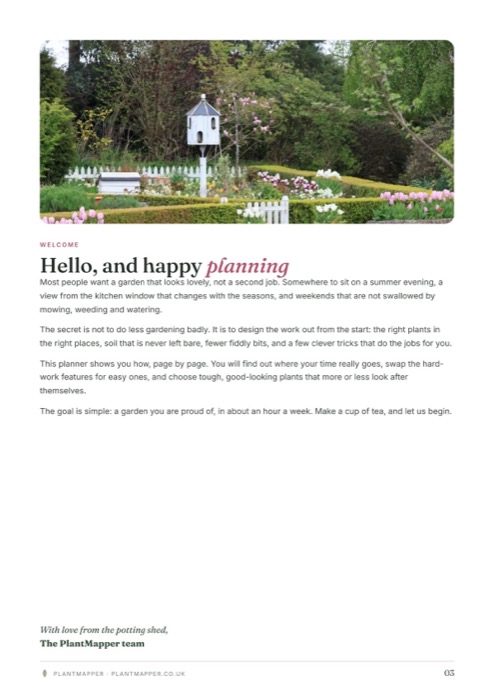
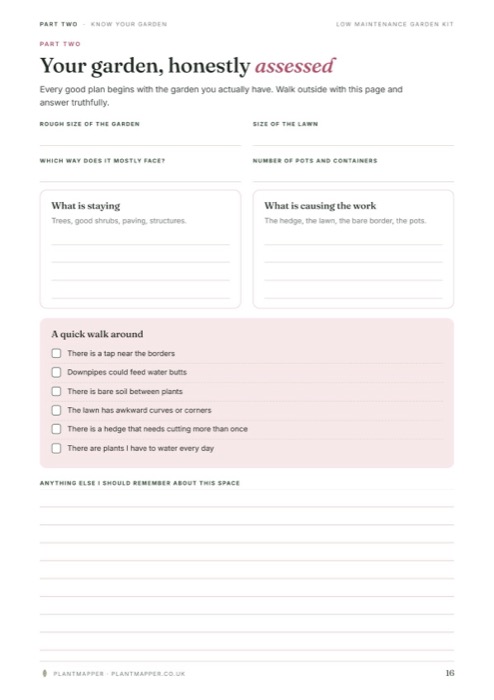
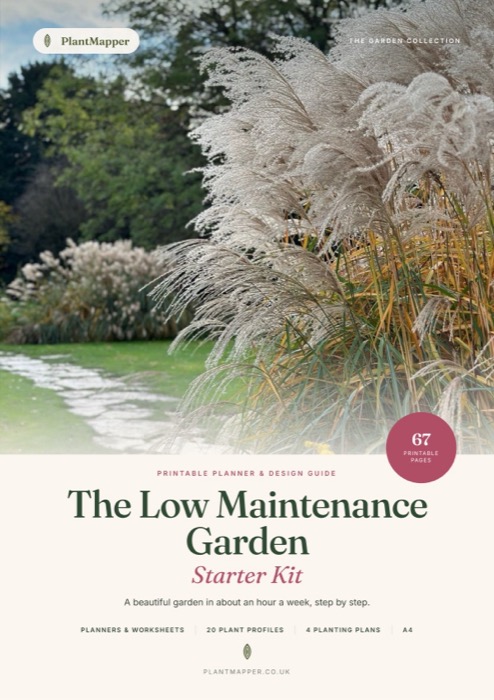
67 Pages Inside page from the Low Maintenance Garden Starter Kit Inside page from the Low Maintenance Garden Starter Kit Cover of the Low Maintenance Garden Starter Kit printable planner 67-page printable planner · US Letter & A4
Common questions

Low-maintenance yards: your questions answered

What is a low-maintenance garden?

A low-maintenance garden, or yard, is planned from the start to look good with as little work as possible. It relies on tough plants suited to your zone and soil, groundcovers and mulch so there is no bare soil for weeds, evergreen structure for winter, less lawn, and drip irrigation instead of hand watering.

How do I make my yard easier to look after?

Shrink the lawn, cover every bit of bare soil with planting or a 2 to 3 inch mulch, replace fussy plants with tough natives and proven performers for your region, swap sheared hedges for shrubs that stay naturally the right size, and put beds on a drip system with a timer. A crisp edge between lawn and beds saves hours of trimming.

What are the best low-maintenance plants?

Reliable choices for much of the US include catmint, sedum, coneflower, black-eyed Susan, bigroot geranium, coral bells, lavender in sunny, well-drained spots, and native grasses such as little bluestem, switchgrass and prairie dropseed. For evergreen structure, try inkberry holly, dwarf yaupon, compact junipers or dwarf mugo pine. Always check a plant against your USDA zone.

What are low-maintenance plants that deer won’t eat?

Deer usually avoid aromatic, fuzzy or tough-leaved plants: lavender, catmint, Russian sage, salvias, bigroot geranium, ornamental grasses, coneflower, yarrow, ferns, boxwood alternatives such as inkberry, and spiky plants like yucca. No plant is completely deer proof, especially in a hard winter, but these are rarely browsed.

What can I plant instead of grass?

Native groundcovers such as Pennsylvania sedge (shade), creeping thyme and sedums (sun), clover or a no-mow fescue mix for light foot traffic, buffalograss or blue grama on the Plains, and in the arid West a gravel garden of drought-tolerant natives. Check HOA rules before replacing a front lawn.

Is vinca a good low-maintenance groundcover?

It is easy, but that is the problem. Periwinkle (Vinca minor and Vinca major) and English ivy are invasive in many states and spread into woodland. Choose native groundcovers instead, such as wild ginger, foamflower, green-and-gold, Allegheny spurge or Pennsylvania sedge.

The small print

Disclosures & disclaimers

Affiliate disclosure

Some links on this page are affiliate links. If you buy through them, PlantMapper may earn a small commission at no extra cost to you. It never changes which products we suggest.

Gardening disclaimer

All advice is general guidance for yards across the US. Results vary with your zone, rainfall, soil and setting, so always confirm a plant’s hardiness and invasive status where you live.

Plant safety note

Some plants, including euphorbia, have irritant sap or are toxic if eaten. Wear gloves when handling them, and check each plant before growing it where children or pets play.