Planning a Raised Planter: Position, Height and Size
With a raised planter, the measurements matter more than the material. Choose the right height, width and spot and it will be comfortable to work at and easy to keep watered for twenty years. Get them wrong and you end up with a good-looking box that hurts your back to reach into and dries out by noon in July.
General guidance for US yards. Any planter holding back more than about 2 ft of soil, or built against a house wall or a property-line fence, needs more care than a weekend project: see the notes on retaining walls and on keeping soil away from siding. Part of the PlantMapper Raised Planters section.
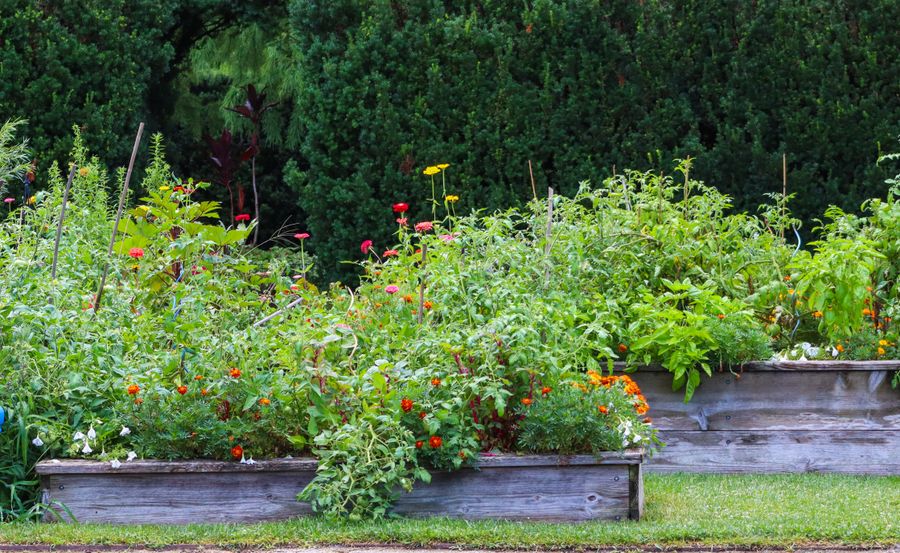
Height, width and position decide how a planter gets used · photograph via Pexels
Start here
What a raised planter is really for
A raised planter is a permanent, free-standing box with its own walls, filled with soil and usually built in place rather than bought and set down. It sits between a raised bed and a big pot, and it is the right answer more often than either.
People build them for four very different reasons, and knowing yours decides almost every choice that follows: growing food without kneeling; getting good soil into a yard that has none (a courtyard, a rooftop deck, a new-build lot of compacted fill); adding structure to a design, where the planter is really landscaping that happens to hold plants; and bringing plants up to a height where they can be enjoyed, tended and reached by everyone.
This guide covers the decisions you make before you choose a material or pick up a saw: what a planter is good at, how it differs from a raised bed and a pot, where to put it, and how big to make it.
Why build one
What a raised planter does well
Six real advantages. None of them is that plants grow faster in a box; they grow better because you control the conditions.
You choose the soil
The biggest single advantage
A planter lets you garden on ground you can't fix: heavy clay, caliche, rocky fill, contaminated urban soil or solid concrete. None of it matters, because you fill the planter with the soil you want.
Ideal where existing soil is poor, compacted or unknown.
Lets you grow acid-loving plants such as blueberries where the native soil is alkaline.
The whole depth is workable from day one, with no buried construction debris.
You can tailor different planters to different crops.
Drainage is far better
Warmer, earlier, drier
Soil held above the ground drains freely and warms up faster in spring, which often gains a couple of weeks at the start of the season, and keeps roots out of waterlogged winter soil.
The trade-off is that planters dry out faster in summer heat.
Comfortable to work at
Less bending, less kneeling
This is why most people build one. A planter about 24 in tall is comfortable for kneeling or perching on the edge; one 30-36 in tall can be worked standing up with no bending at all.
Makes gardening possible again for anyone with back, hip or knee problems.
Can be built to wheelchair height with knee clearance underneath.
Children can reach into a low planter without stepping on the soil.
The soil is never walked on
Structure that lasts
Because you work from outside, the soil in a planter never gets compacted. It stays loose and crumbly, which is why planters need so much less digging than in-ground beds.
No yearly digging; just top up with compost.
Better root growth and drainage year after year.
Weeding is quicker because the soil stays loose.
Structure in the design
Landscaping that grows things
A pair of planters can frame a patio, screen a property line, break up a long narrow yard or turn a bare courtyard into an outdoor room. This is the reason to build in brick, stone or steel rather than boards.
Adds height and permanence that pots can't.
Doubles as casual seating when built with a wide cap.
Works especially well where planting space is limited.
Fewer pests, easier protection
Not pest-proof, but easier
Slugs still climb, but a smooth-sided planter at height has far fewer problems than an in-ground bed, and the defined shape makes it easy to fit bird netting, row cover or hoops.
Copper tape works well on a smooth planter rim against slugs.
A planter about 2 ft tall keeps most rabbits out by height alone (deer are another matter).
A fixed frame for netting or row cover can be built into the structure.
The first decision
Raised planter, raised bed or container?
People use these three words interchangeably, but they are not the same thing. The difference is whether the soil inside is connected to the ground below, and that changes watering, cost, depth and what you can grow.
Raised planters, raised beds and containers compared.
Raised planter
Raised bed
Container / pot
What it is
A permanent walled structure with a closed or partly closed base, filled entirely with brought-in soil
A low frame sitting on soil, open at the bottom so roots reach the ground below
A free-standing pot or trough that can be moved
Typical height
18-36 in
6-18 in
12-24 in
Soil volume
Large: all of it brought in
Moderate: topped up over ground
Small
Watering
Moderate; a deep planter holds water well
Lowest: roots can reach ground moisture
Highest: often daily in summer
Cost to fill
Highest: a 6 x 3 ft planter 2 ft deep takes about 36 cu ft (1.3 cu yd)
Low to moderate
Low
Best for
Accessibility, hard surfaces, poor or contaminated ground, structure in a design
Vegetable growing on reasonable soil, community gardens, larger areas
Seasonal color, herbs by the door, small spaces, renters
Root depth available
Whatever you build; 16 in or more is plenty for most crops
Effectively unlimited
Limited to the pot
Can it go on paving?
Yes, that is one of its main uses
Only with a solid base and full depth of soil
Yes
Permanence
Permanent
Semi-permanent
Movable
✓Build a raised planter when
You want to garden without kneeling, or need wheelchair access.
The site is a patio, concrete slab, rooftop deck or courtyard.
The existing soil is contaminated, unknown or truly unworkable.
You want the structure to do a landscaping job as well as a growing one.
You want something that will still look right in fifteen years.
!A raised bed or a pot is the better answer when
The ground underneath is decent soil: a raised bed is cheaper and needs far less water.
You are growing over a large area, where filling planters gets expensive.
You rent, or may want to change the layout: pots move, planters don't.
You only want herbs by the back door or a season of color.
Budget is tight: the soil to fill a big planter often costs more than the lumber.
If you mainly want to grow vegetables on ground that is basically sound, read the Raised Beds guide instead; it is the cheaper and more productive route. Come back here if the ground is hard, the site is paved, or reaching down is the problem you are solving.
Where to put it
Choosing a position
A planter is permanent and heavy, and once filled it can't be moved. Spend an afternoon on this before you commit; it is the decision people most often regret.
Follow the sun, not the leftover space
Most vegetables want 6-8 hours of direct sun; tomatoes, peppers and eggplant want all they can get. Herbs are similar. Lettuce, chard, kale and many ornamentals are happy with four to five hours, and in hot southern and desert summers they appreciate afternoon shade.
Watch the spot across a full day before deciding, and remember the sun is much lower in spring and fall than on the July afternoon when you are planning.
Put it where you walk past it
A planter you see every day gets watered, picked and enjoyed; one at the far end of the yard behind the shed doesn't. How often you pass it is the best predictor of whether it succeeds.
For herbs and salad greens, a few steps from the kitchen door is worth more than an extra hour of sun.
Keep it close to water
Planters need watering far more often than in-ground beds, and dragging a hose across the yard in a July heat wave is how good planters get abandoned. Site it within hose reach of a spigot, or plan a rain barrel nearby where your local rules allow.
If you can't get water to it easily, either move it or plan a drip line from the start.
Keep clear of house walls, fences and property lines
Never pile soil against a house wall. Soil holds moisture against the foundation and siding and gives termites a hidden route into the framing. Leave a gap of at least 4 in, and keep the soil well below the bottom of any wood siding (building codes generally require at least 6 in of clearance between soil and wood framing or siding).
Wood fences are not built to hold back soil. A planter must stand on its own, clear of the fence, with a gap behind so the fence can dry out and be maintained. Check where your property line is before building next to it.
Check what is underneath and overhead
Before building anything permanent, call 811 (the free national Call Before You Dig number) to have buried utility lines marked, and look for sprinkler lines, cleanouts, septic components and water shutoffs. Never build over an access point you may need to reach.
Overhead, avoid building under a tree: dry shade, root competition, sticky sap and falling leaves all make it a poor spot.
Think about how you will get around it
A planter needs working space on every side you use. Allow 2 ft for comfortable access, 3 ft where you will push a wheelbarrow or carry a full watering can, and 3-4 ft for a wheelchair (with a 5 ft turning circle).
A planter against a wall can only be worked from one side, which limits its sensible width to about 2 ft.
The numbers that matter
Height, width and depth
Three dimensions, three separate decisions. Height is about your body, width is about your reach, and depth is about the plants.
Height: decided by how you want to work
Height is the dimension people get wrong, usually by building too low because it takes less material. Choose it from how you plan to use the planter, not from the board sizes at the lumber yard.
12-18 in - really a deep raised bed rather than a planter. Fine for vegetables if you don't mind kneeling, and the cheapest to fill.
18-24 in - the most popular height. Comfortable for kneeling or sitting on the edge, and deep enough for anything short of a tree.
24-30 in - perch-and-work height. Comfortable for most people standing with a slight bend, and the usual choice when back trouble is the reason for building.
30-36 in - full standing height, no bending at all. Also the range for wheelchair use, where about 30 in to the top of the soil is typical.
Over 36 in - you can no longer see or reach into the middle. Only sensible as a narrow trough or a purely ornamental structure.
Try it before you build: stack something to the planned height and spend two minutes pretending to weed it. A five-minute test prevents a permanent mistake.
Width: decided by your reach
You must be able to reach the middle without climbing into the planter. Most adults have a comfortable working reach of about 2 ft, less if the planter is tall or you are seated.
Worked from both sides: up to 4 ft wide. This is the standard for a free-standing planter.
Against a wall or fence, one side only: 2 ft maximum.
Wheelchair users, both sides: about 3 ft; from one side, 18-24 in.
Children: 2-3 ft from both sides.
Length is much less critical, since you simply walk along it. Beyond about 8 ft, though, wood sides need a middle post or cross-tie to stop the boards bowing out under the weight of wet soil.
Two 6 ft planters with a path between them are almost always more useful than one 12 ft planter: you gain a second working face and can rotate crops between them.
Depth: decided by what you grow
Soil depth is not the same as planter height. A tall planter can be partly filled with a drainage and bulk layer, which saves a lot of money on soil.
6-8 in - lettuce, radishes, most herbs, succulents, spring bulbs.
10-12 in - beets, onions, garlic, chard, bush beans, most annual flowers and perennials.
12-16 in - carrots, potatoes, broccoli and cabbage, zucchini, tomatoes, ornamental grasses and small shrubs. This is the sensible all-purpose minimum.
18-24 in - parsnips, long carrots, larger shrubs, roses, small ornamental trees.
24 in and deeper - established shrubs and small trees, or anywhere the planter sits on solid concrete with nothing below.
If the planter sits on open soil rather than paving, roots will grow down into the ground below and depth matters less. On a hard surface, what you build is all they get.
Shape and proportion
Long rectangles are the most practical shape and the easiest to build. Squares look settled and work well in pairs. L-shapes fit corners and courtyards. Curves look wonderful but rule out wood boards; they need brick, stuccoed block or a fabricated metal unit.
Proportion matters more than people expect. A tall, narrow planter reads as a trough; a long, low one reads as a bed. As a rough guide, a height of about half the width looks settled, and anything much taller than it is wide looks like furniture rather than landscaping.
Where planters are the backbone of a design, repeat one size rather than making each one different, and line the tops up level even if the ground slopes. Two matching planters at the same height always look more considered than three different ones.
Repeating one size reads as design rather than accumulationTwo planters and a path beat one wide planter almost every timeHeight is chosen from how you want to work, not from what timber comes in
Designing for everyone
Accessibility and child safety
If accessibility is the reason you are building, the details below are not extras; they are the whole point, and they need to be designed in from the start.
✓Designing for wheelchair and seated use
Top of the soil at about 30 in, with the rim no higher than about 34 in.
Knee clearance under the planter on at least one side: a recess about 27 in high and 12 in deep lets a chair pull right in.
Maximum 2 ft wide when worked from one side, about 3 ft from both.
A firm, level, slip-resistant approach on every working side: not loose gravel, and not lawn that turns to mud.
A 5 ft turning space at the end of a run, and 3-4 ft along it.
A smooth, wide cap rail, with no splinters, sharp edges or sticking-out fasteners.
!Designing with children in mind
Keep it low: 12-18 in is right for young children and lets them reach in without climbing.
Round off or bevel every corner and edge at a child's head height.
No protruding screws, nails, wire or sharp metal; check the inside faces as well as the outside.
Avoid freestanding sheet metal with raw cut edges, and loosely stacked blocks that can be pulled over.
Never use old creosote-treated railroad ties; they are not suitable for home gardens, food growing or play areas. See Landscape timbers and railroad ties.
Give children their own planter rather than a corner of yours. It is the single best way to get them interested.
A wide cap rail, 6 in or more, is the most useful detail you can add to any planter. It gives you somewhere to sit, set down a tray or a coffee, lean while working, and it protects the top of the structure from rain. It costs very little and changes how much the planter gets used.
Fitting them in
Layout, paths and spacing
Planters take up more room than their footprint. The space around them is what makes them usable, and it is usually the first thing to get squeezed.
Working space around raised planters. Measure the clear width, not center to center.
Situation
Clear space needed
Notes
Between two planters, occasional access
18-24 in
Enough to walk and kneel; too narrow for a wheelbarrow
Main working path
2-3 ft
Comfortable with a watering can, a kneeler or a basket
Wheelbarrow access
3 ft minimum
Measure your wheelbarrow: the handles are wider than the tray
Wheelchair route
3-4 ft
With a 5 ft turning space at the end
Between a planter and a wall
4 in minimum, 18 in if you need to get behind
A gap keeps moisture and termites away from the house; any less and you can never maintain either
Behind a planter against a fence
6-12 in
So the fence can dry out and be repaired or replaced without taking the planter apart
In front of a seating area
30 in
Allows a chair to be pulled back
Mark the whole layout on the ground with string, flour or a garden hose and live with it for a few days before you build. Walk the routes with a full watering can and a wheelbarrow. Paths that look generous on paper are often 6 inches too narrow in real life.
Budgeting
Cost and quantities
Two things surprise people: how much soil a planter swallows, and how often the fill costs more than the structure. Work out the volume before you set the budget.
Rough US material costs for a raised planter, structure only (add the fill below). Prices vary widely by region and supplier, so treat these as a starting point and get local quotes.
Material
Cost per linear foot (approx.)
Life expectancy
Skill needed
Untreated pine or reclaimed lumber
$2-$6
3-7 years
Low
Pressure-treated lumber, ground-contact rated
$4-$10
10-15 years
Low
Treated landscape timbers (6x6)
$6-$12
15-20 years
Low to moderate: they are heavy
Cedar or redwood boards
$10-$25
10-20 years
Moderate
Composite boards on a frame
$15-$35
20-25 years
Low to moderate
Galvanized or Corten steel
$20-$60
20 years plus
Low: usually bought as a kit
Brick on a concrete footing
$40-$80
50 years plus
High: usually a mason
Stucco-finished concrete block
$30-$60
40 years plus
Moderate to high
Natural stone
$50-$120
Effectively permanent
High
What it costs to fill. Volume in cubic feet = length x width x soil depth, all in feet; divide by 27 for cubic yards.
Planter (L x W x soil depth)
Volume
Bagged soil equivalent
Typical bagged cost
4 x 2 ft x 16 in
10.7 cu ft (0.4 cu yd)
about 7 x 1.5 cu ft bags
$55-$105
6 x 3 ft x 16 in
24 cu ft (0.9 cu yd)
about 16 x 1.5 cu ft bags
$130-$240
8 x 4 ft x 16 in
42.7 cu ft (1.6 cu yd)
about 29 x 1.5 cu ft bags
$230-$435
8 x 4 ft x 24 in
64 cu ft (2.4 cu yd)
about 43 x 1.5 cu ft bags
$345-$645
10 x 4 ft x 24 in
80 cu ft (3 cu yd)
about 54 x 1.5 cu ft bags
$430-$810
Costs assume roughly $8-$15 per 1.5 cu ft bag of garden or raised bed soil. Above about 1 cubic yard, ordering a bulk soil-and-compost blend by the cubic yard from a landscape supply yard is usually much cheaper and saves a lot of carrying, even with a delivery fee. The soil calculator will work out the volume for you.
Work out exactly how much soil you need
Enter the length, width and depth of your planter and the calculator gives you the volume, the number of bags and the bulk amount to order.
All six are decided before anything is built, and all six are permanent once it is.
1. Building it too low
Almost everyone builds lower than they should, because boards come in standard widths and it saves material. Then they spend fifteen years kneeling at a planter they built to avoid kneeling.
The fixChoose the height from how you want to work, then buy material to suit, not the other way around. Mock up the height and pretend to weed it before you commit.
2. Making it too wide to reach across
A planter wider than 4 ft when worked from both sides, or 2 ft against a wall, has a dead zone in the middle that never gets weeded, watered or picked properly.
The fixMeasure your own comfortable reach and design to it. Two narrower planters with a path between them give you more usable growing space than one wide one.
3. Squeezing the paths
Paths get squeezed to fit in one more planter, and then a full watering can won't pass, let alone a wheelbarrow. It is the most common regret in a planter layout.
The fixLay out the paths first, walk them with a wheelbarrow and a full can, and fit the planters into what is left.
4. Building against the house wall
Soil piled against a house holds moisture against the foundation and siding, invites rot, and gives termites a hidden way in.
The fixLeave a gap of at least 4 in behind any planter near the house, keep the soil well below wood siding, and if you are unsure about levels or drainage, have a contractor take a look.
5. Forgetting how it will be watered
A planter dries out much faster than an in-ground bed, and one beyond hose reach gets watered enthusiastically in May and forgotten by August.
The fixSite it within hose reach or plan a drip line and a rain barrel from the start. It is far easier to run a line before the planter is built than after.
6. Underestimating what the fill will cost
People budget carefully for the lumber and then find the soil to fill it costs more. An 8 x 4 ft planter 2 ft deep needs about 64 cu ft, nearly 2.4 cubic yards.
The fixWork out the volume at the planning stage, price bulk delivery rather than bags, and use a bulk layer in the bottom third of a deep planter to cut the amount of soil needed.
Print or tick as you go
The planning checklist
Twelve decisions to settle before you buy anything. Your ticks are saved in this browser only.
Position
Dimensions
Layout and budget
Questions
Planning a raised planter: your questions answered
Answers to the questions that come up most.
What is the difference between a raised planter and a raised bed?
A raised bed is a low frame sitting directly on the ground and open at the bottom, so roots grow down into the soil below. A raised planter is a taller, permanent structure with a closed or partly closed base, filled entirely with brought-in soil, so it can stand on a patio, a concrete slab or a rooftop deck. Planters are typically 18-36 in tall against 6-18 in for a bed, cost more to fill and need more watering, but they can go where a raised bed can't and can be built to a comfortable working height.
How tall should a raised planter be?
It depends on how you want to work at it. 18-24 in is the most popular height and is comfortable for kneeling or sitting on the edge. 24-30 in suits perching and working with only a slight bend, and is the usual choice if back trouble is the reason for building. 30-36 in allows full standing use with no bending, and about 30 in to the top of the soil is the normal height for wheelchair access. Above 36 in you can no longer see into the middle.
How wide should a raised planter be?
No wider than you can comfortably reach into the middle without climbing in. For most adults working from both sides that means about 4 ft at most; against a wall or fence, where you can only work from one side, 2 ft is the limit. For wheelchair users allow about 3 ft from both sides or 18-24 in from one. Length matters less, though wood sides longer than about 8 ft need a middle post to stop them bowing.
How deep does a raised planter need to be for vegetables?
About 12-16 in of soil handles almost everything most people grow: carrots, potatoes, broccoli, zucchini, tomatoes, beans and salad greens. Lettuce, radishes and herbs will manage in 6-8 in. Parsnips, long carrots and anything shrubby want 18 in or more. Soil depth and planter height are different things: a deep planter can be partly filled with a bulk layer underneath, which saves a good deal of money on soil.
Can I put a raised planter on a patio or concrete?
Yes, that is one of the main reasons to build a planter rather than a raised bed. The surface must be sound and fairly level, the planter needs drainage holes or gaps so water can escape, and it should sit on feet, runners or a gravel layer so the base isn't sitting in a puddle. Remember the weight: wet soil weighs roughly 90-100 lb per cubic foot, so a filled planter is not something a deck, balcony or rooftop can take without checking the structure first.
How much soil do I need to fill a raised planter?
Multiply length x width x soil depth, all in feet, to get cubic feet, then divide by 27 for cubic yards. A 6 x 3 ft planter with 16 in of soil needs about 24 cu ft, roughly sixteen 1.5 cu ft bags. An 8 x 4 ft planter with 2 ft of soil needs about 64 cu ft, or 2.4 cubic yards. Above about a cubic yard, bulk delivery from a landscape supply yard is usually much cheaper than bags. The soil calculator does the math for you.
Can I build a raised planter against a house wall or fence?
Against a house, only with care: leave a gap of at least 4 in and keep the soil well below wood siding, since building codes generally require about 6 in of clearance between soil and wood. Soil against the house holds moisture and can give termites a hidden way in. Against a fence, build the planter free-standing with a gap of 6-12 in behind it; a fence is not built to hold back soil, and you will want to repair or replace it without taking the planter apart.
Do I need a permit to build a raised planter?
A normal garden planter usually doesn't need a building permit. It is worth checking with your local building department if the structure is unusually tall, forms part of a property-line wall, holds back a significant change in grade, or if your HOA has rules on yard structures. In many places, retaining walls taller than about 4 ft need a permit and sometimes an engineer, so anything holding back more than about 2 ft of soil should be treated as a retaining wall rather than a planter.